

For parents

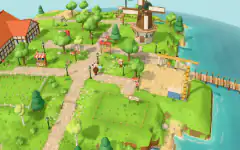
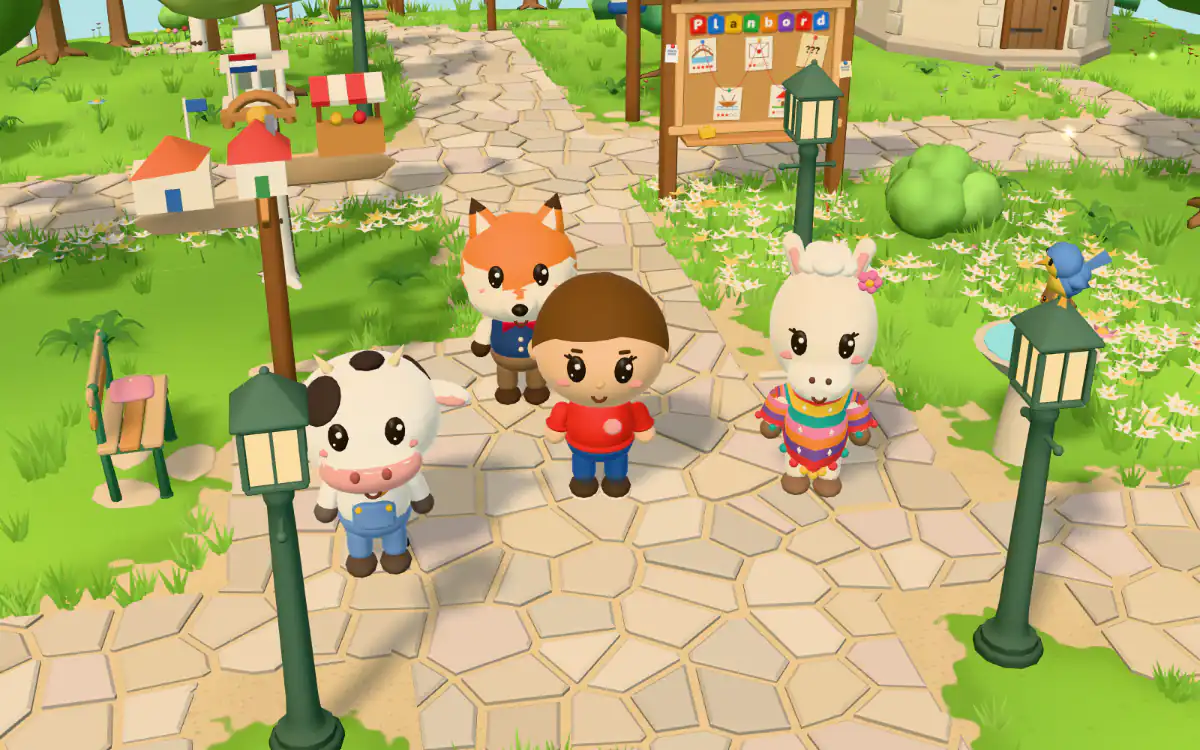
The village square on your own island in Vilago, with a girl, Kees the Cow, Oliver the Fox and Lucía the Llama. Behind them are the Plan board and a birdbath.
Your own island

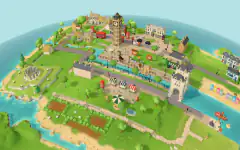
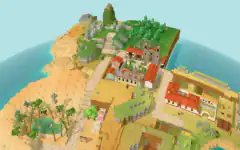
Your child starts on an island of their own, together with Kees the Cow, Oliver the Fox and Lucía the Llama. Help the animals, go exploring and the island keeps growing. You design your own house, open a museum and a shop, and build whatever you like.

Build the bridge with Kees and travel to the Netherlands. Cycle past windmills, sail along the Rhine and collect souvenirs for your museum. You row to England in a boat you built yourself: have tea with Hettie the Hedgehog, hop on the double-decker and visit Big Ben. You fly to Peru with Lucía in a seaplane: sandboard down the dunes at Huacachina, wander through Cusco and climb up to Machu Picchu. Italy comes after that.

  • No chat with other players
  • No hidden purchases with real money

What your child meets along the way

  • How much material do you need to build something?
  • Where is the Dutch province this letter has to go to?
  • How much change do you get at the market?
  • What does Lucía ask you in Spanish?
  • How many grams of butter go into Hettie’s cake?

How learning is woven into the world

The island paper

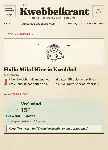
Every day your child plays, Kwebbel the gull delivers a paper full of weather reports, island news, charts and estimation questions. From school year (groep) 6, about age 9 an item is sometimes not true, such as a letter from ‘K3es’ asking for a secret code. Your child decides what is true. In England your child takes photos for Gulliver the Gull’s front page, and from school year (groep) 6 he first asks whether his headline is true, a bit too much or just silly. Good for reading comprehension and media literacy. For now the paper’s stories are written in Dutch.
Post from all corners

Kees the postman can always use a hand. Your child sorts letters on the map table by Dutch province, and the people who get them often write back enthusiastically. If you write a letter yourself in the parents’ corner, it really lands in the mailbox by the hotel next time.

Build, try, build again

On the island you design and build all the time: furnishing your own house, laying paths and building bridges. In school year (groep) 8, age 11 to 12, for example, your child works out how many planks of one and a half metres fit into a span of eighteen metres. If the sum is wrong, there is a gap in the bridge. For the Tree House your child measures and saws planks to size with Kees, in metres and centimetres. Younger players count blocks, older ones work with area and perimeter.

The Builder Bot In the making

The Builder Bot is on our drawing board: a clever little robot that does exactly what you tell it. You program its route with arrows. Later come repeats, conditions and programs written by Kees with a mistake in them for your child to track down. The basics of programming and logical thinking, just while playing.

Playing with water and land

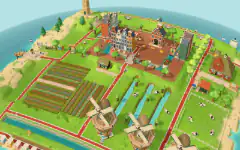
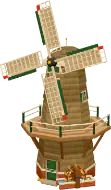
On the island you can dig, make hills and lay paths. Oliver and Lucía sometimes ask for a job of a specific size, and then your child has to calculate. From school year (groep) 5, about age 8 you make a polder with Kees, a piece of land reclaimed from the water: you build a dyke, the windmill pumps the water away and new land appears, with ditches between the fields.

To the market and the museum

On Fridays it is market day on the square in the Netherlands. Pay in euros and count your change. Sometimes there is a discount, and older children work with cents and percentages. In Cusco’s market hall your child pays for Doña Rosa’s juice in soles, and in Hettie’s kitchen they weigh the flour in grams. Whoever helps Kees in the Netherlands brings a souvenir home for the museum on the island.

The world keeps growing

Now you can visit the Netherlands, England and Peru. Italy comes after that. Got suggestions or ideas of your own? Please share them with us!

  1. Your own island Home base

    This is where your adventure starts. Build your own house, furnish it the way you like, help the animals and pick your clothes from the wardrobe. On the headland you build the Tree House with Kees. As soon as the bridge is finished, you can walk straight to the Netherlands.

  2. The Netherlands Playable now

    Collect the twelve provinces for Kees’s puzzle on the map table, sail along the Rhine and travel along the Wadden Islands, a chain of islands off the north coast. Help Kees with real jobs: weigh cheese at the weigh house, find clogs in the right size and count bikes in the rack. Pick up typically Dutch souvenirs for your museum. Older players also meet provincial capitals and the topography of the Netherlands.

  3. England Playable now

    Build a rowing boat with Oliver and sail up the Thames, under Tower Bridge. Bake a Victoria sponge with Hettie the Hedgehog, take a photo for Gulliver the Gull’s paper and look for crabs in the rock pools. The village is getting ready for a fête: every story you finish puts something up. At the market you pay in pounds. Everyone there speaks English, of course.

  4. Peru Playable now

    Lucía the Llama invites you to Peru. Together you build a little airfield on the sea, and the seaplane takes you there. You order juice in Cusco’s market hall and pay in soles, look for dye plants for Sisa and count the Inca way with Zeze, with knots in a quipu. With Lucía you fit the stones of Sacsayhuamán back into the wall. You choose how much Spanish you hear: A sprinkle, More Spanish or All Spanish.

  5. Italy Up next

    After Peru, we’re off to Italy. Where we go after that is still open. The children have already suggested France and Spain.

Languages are part of the world

Kees chats in your own language. Lucía speaks Spanish, and how much of it she uses with your child, from a few words to all of it, is your choice (see below). Tap a word to hear the translation or pronunciation, have a sentence read aloud or ask for a hint. Children choose whether to answer out loud or tap an answer instead.

How much Spanish your child hears is a choice per child, for Lucía at home and everyone in Peru. A sprinkle: their own language with a few Spanish words that keep coming back, like hola and gracias. More Spanish: short lines and questions in Spanish, with the translation under them. All Spanish: everything in Spanish, with help whenever they need it. Your child picks before the first flight to Peru, and you can change it in the parents’ corner.

At first the game helps a lot. When it goes well, that support fades into the background step by step. Words you learned earlier come back in later chats.

Made for ages 7 to 12

At the start you pick your child’s school year (groep). In Dutch primary school, groep 4 is age 7 to 8 and groep 8 is age 11 to 12. Vilago adjusts the difficulty skill by skill. Is your child quick at sums but finding Spanish tricky? Then the sums get harder and the Spanish sentences stay simple.

What differs per school year, for example
School year (groep) For example
4 Lots of reading aloud, short sentences, clear visual explanations and an unhurried pace.
5 Counting and area when building, left and right on the water.
6 Paying in euros and cents at the market, and telling the time.
7 Working out discounts and ratios, and averages.
8 Perimeter when building, topography and riddles about the Dutch provinces and neighbouring countries.

Under the hood the tasks follow the Dutch primary-school core objectives (kerndoelen). In the parents’ corner you can see clearly which areas your child has practised.

For children it never feels like a row of sums: they build a bridge, buy things at the market or sail a safe route.

Play time and pace

Vilago leaves plenty of room to build, look around and discover at your own pace.

In the parents’ corner you can set a daily play time. When the time is almost up, the sky turns orange and your child can wrap up calmly.

Play time per day, in the parents’ corner:

  • 20 min
  • 30 min
  • 45 min
  • 60 min
  • No limit

The parents’ corner

In the parents’ corner you follow along, change settings and add something to the game yourself.

  • Progress

    See the play time, the level per subject and what your child has been practising lately.

  • Settings

    Choose the school year (groep), adjust the starting level and set the daily play time. Switch a foreign language off and the animals simply speak your child’s own language.

  • Things from home and letters

    Add your own questions or facts for Kees to ask along the way. Or write a letter that really ends up in the mailbox by the hotel.

  • Starting over or moving

    Choose which parts may start again, or save a player as a file to carry on playing on another device.

You find the parents’ corner on the start screen under For parents. A four-digit code keeps children out. Forgotten the code? Solve a tricky multiplication and choose a new one.

Keep playing anywhere

At school, at a friend’s house, on another iPad.

Without an account everything stays on the device your child plays on. Create a free account as a parent and your child can pick up where they left off, on any device. It keeps a backup too.

  • Progress, islands and game records are the same on every device.
  • Your child logs in with their player name and the picture password (three pictures you set in your account). With a card with a QR code the name fills itself in; the pictures are still needed.
  • You create the account in the game’s parents’ corner. You give consent by email, and your child doesn’t need an email address of their own.

What we store

Privacy

Without an account everything your child builds and learns stays safely on this device. No tracking cookies and no hidden costs. Want your child to be able to play at school or on another device too? Then you can create a free parent account. You can read all the details on the privacy page.

Enough explaining. Try it yourself.

Play Vilago

Free in your browser. No account needed.